Interested in joining Holcombe Grammar School Sixth Form in September 2026?

Unlock your potential and join a vibrant, ambitious community at Holcombe Grammar Sixth Form. Apply now to explore inspiring courses, exceptional teaching, and a supportive environment that prepares you for your future goals. Click this link to register your interest and begin your journey with us for September 2026.

Physics

Curriculum Intent

Physics is taught at Holcombe Grammar School across all three Key Stages. At KS3 it is taught as part of the Science curriculum, whilst at KS4 students have the choice of studying Physics as either a standalone GCSE or as part of the Combined Science course.

Physics is also offered as an A-level option at KS5. The fundamental approach taken across all three key stages is designed to provide students with a robust, knowledge rich curriculum whilst providing them with a multitude of opportunities to apply and evaluate their understanding. Students are encouraged and supported to take a central role in their learning, utilising the thinking toolkit and with particular emphasis on Reflection, Retrieval and Interleaving of Knowledge.

Key Stage 3

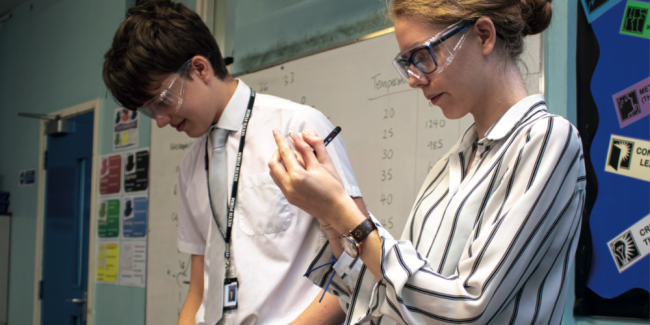
Science is taught with a hands-on approach here at Holcombe Grammar School. The Science curriculum is made up of topics in Biology, Physics and Chemistry. We build upon the students’ experience of Science in primary school and provide fantastic foundations for further learning at GCSE. We strive to spark our students’ curiosity in the world around them so that they can understand the scientific implications that impact on their own lives. We aim to build knowledge, understanding and investigative skills. Students have six lessons of Science per fortnight. Students are assessed on their knowledge during each topic, as well as undergoing constant assessment on how well they apply their scientific knowledge and practical skills.

Year 7

Term 1Term 2Term 3Term 4Term 5Term 6
 Forces – Speed and Gravity Electromagnets - voltage
Electromagnets - Resistance and current
 Energy – Costs and Transfer


Year 8

Term 1Term 2Term 3Term 4Term 5Term 6
Waves - Sound and LightWaves - Sound and Light
Force - contact force and pressure


Electromagnets - magnetism and electromagnetism 


Year 9

Term 1Term 2Term 3Term 4Term 5Term 6

Maths in Physics

Energy - Stores and Transfers

KE, GPE and EPE

Power and efficiency

Heating and Cooling

Internal Energy, Specific Heat capacity and SpecificEnergy ResourcesDensity and particles

KS3 Learning Journey

Please see attached Key Stage 3 Learning Journey for Physics.

Key Stage 4

Course Title

Combined Science – two GCSEs

Or Triple Science – three separate GCSEs in Biology, Chemistry and Physics

Examination Board

AQA


Examination and Coursework Details

Each GCSE will have a terminal examination worth 100% of the overall mark.

Course Outline

All students will study for a minimum of two science GCSEs (Combined Science covers all three Science subjects -Biology, Chemistry and Physics and is worth two GCSEs). In all three subjects the specifications place an emphasis on ‘working scientifically’, teaching science through contemporary issues and communication of scientific ideas. ‘Working scientifically’ involves students looking at how scientific developments progress, the need to use data to support or disprove ideas and why data may not be reliable. The aim is to give the students the ability to analyse complex problems and to decide for themselves what solutions are appropriate using the available data.

The Biology course offers pupils the opportunity to examine how the body responds to the environment, keeping healthy, drugs and their implications, the body’s responses to infectious disease, factors affecting a species distribution and genetic inheritance, endangered species and how humans affect the environment, the effect of enzymes, micro-organisms and internal body systems and control.

The Chemistry course allows pupils to understand atomic structure, structure and bonding, calculations, chemical reactions, electrolysis, energy in reactions, rates of reaction, carbon compounds, the atmosphere and the use of resources.

The Physics course allows pupils to investigate thermal changes, efficiency of energy transfer and loss, electrical devices and circuits, generation of electricity using alternative sources, radiation and its uses and dangers, origins of the universe, how objects speed up or slow down, static electricity, current electricity, turning effects, mirrors and lenses as well as transformers.

Cross-Curricular Links

Students will develop their mathematical skills in practical situations. They will have the opportunity to discuss scientific ideas and controversies and present information using a range of technologies.

Sixth Form and Career Opportunities

The course provides a firm foundation for students who intend to study an A-level science. It develops critical thinking as well as problem solving skills allowing pupils to make informed evaluations of current scientific developments. Providing for jobs in health care, pharmaceuticals and bio-chemistry sectors as well as bio-medical research, engineering and construction.


Year 10

Term 1Term 2Term 3Term 4Term 5Term 6

Triple -

Topic 4.1: Energy - 

RP1: investigate specific heat capacity

RP2: Investigate thermal insulation

Combined - 

Topic 6.1: Energy -

RP17: investigate specific heat capacity

Triple -

Topic 4.3: Particle Model

RP5: investigate density

Combined -

Topic 6.3: Particle Model

RP20: investigate density

Triple -

Topic 4.4: Atomic structure

Combined -

Topic 6.4: Atomic structure

Triple - 

Topic 4.5.6.1: Describing motion along a line

Topic 4.5.1: Forces and their interactions

Topic 4.5.3: Forces and elasticity

RP6: investigate the relationship between force and extension for a spring.

Combined -

Topic 6.5.6.1: Describing motion along a line

Topic 6.5.1: Forces and their interactions

Topic 6.5.3: Forces and elasticity

RP21: investigate the relationship between force and extension for a spring.

Triple -

Topic 4.5.2: Work done and energy transfer

Topic 4.5.6.2: Forces, accelerations and Newton's Laws of motion

RP7: investigate the effect of force and mass on acceleration.

Combined -

Topic 6.5.2: Work done and energy transfer

Topic 6.5.4.2: Forces, accelerations and Newton's Laws of motion

RP22: investigate the effect of force and mass on acceleration.

Triple - 

Topic 4.5.6.3: Forces and braking

Topic 4.5.4: Moments

Topic 4.5.7: Momentum

Topic 4.5.6: Pressure

Topic 8: Space

Combined -

Topic 6.5.4.3: Forces and braking

Topic 6.5.5: Momentum

Topic 6.5.7: Momentum

Year 10 and 11 students who study triple science also cover the combined science topics as stated in the table.


Year 11

Term 1Term 2Term 3Term 4Term 5Term 6

Triple -

Topic 4.2: Electricity

RP3: investigate the factors affecting electrical resistance.

RP4: investigate the I–V characteristics of a variety of circuit elements

Combined -

Topic 6.2: Electricity

RP18: investigate the factors affecting electrical resistance.

RP19: investigate the I–V characteristics of a variety of circuit elements

Triple -

Topic 4.2: Electricity

RP3: investigate the factors affecting electrical resistance.

RP4: investigate the I–V characteristics of a variety of circuit elements

Topic 6.2: Electricity

RP18: investigate the factors affecting electrical resistance.

RP19: investigate the I–V characteristics of a variety of circuit elements

Triple - 

Topic 4.6.1: Waves in air, fluids and solids

RP8: measure the frequency, wavelength and speed of waves in a ripple tank and waves in a solid.

RP9: investigate reflection and refraction of light.Topic 4.6.2: Electromagnetic waves

RP10: investigate how amount of infrared radiation absorbed or radiated depends on surface

Combined -

Topic 6.6.1: Waves in air, fluids and solids

RP23: measure the frequency, wavelength and speed of waves in a ripple tank and waves in a solid.

Topic 4.6.2: Electromagnetic waves

RP24: investigate how amount of infrared radiation absorbed or radiated depends on surface

Triple - 

Topic 4.6.2: Electromagnetic Waves

Topic 4.7: Magnetism and electromagnetism

Combined -

Topic 6.7: Magnetism and electromagnetism

GCSE ExamsGCSE Exams

Year 10 and 11 students who study triple science also cover the combined science topics as stated in the table.

KS4 Learning Journey

Please see attached Key Stage 4 Learning Journey for Physics.

Years 12 and 13

Physics attempts to describe how our universe works using the language of mathematics. It is the most fundamental of all the natural sciences and its theories attempt to describe the nature and explain the behaviour of matter, light, and all other phenomena. Studying physics offers the opportunity to develop the knowledge, practical and mathematical skills to solve problems ranging from the very large, with stars, planets and galaxies, to the very smallest building blocks of matter in the standard model of particle physics.

Year 12

Term 1Term 2Term 3Term 4Term 5Term 6
Topic  1 Measurement and Errors
Topic 3 Waves : Progressive and Stationary waves
Topic 3 Waves : Refraction, diffraction and interferenceTopic 4 Mechanics: Statics and KinematicsTopic 4 Mechanics: Kinematics and DynamicsTopic 4 Materials; DynamicsRevision
 
Topic 2: Particles and Radiation: ParticlesTopic 2: Particles and Radiation: Radiation and quantum physicsTopic 5 Electricity: Current ElectricityTopic 5 Electricity: Current ElectricityTopic 5 Electricity: CircuitsRevision


Year 13

Term 1Term 2Term 3Term 4Term 5Term 6

Topic 6: Further Mechanics

Topic 7 Fields: Gravitational Fields

Topic 7 Fields: Electric Fields; CapacitorsTopic 7 Fields: Electromagnetic Induction; Magnetic Fields

Topic 7: Fields: Electromagnetic Induction

Revision

RevisionExams

Topic 6: Thermal physics

Topic 8: Nuclear

Topic 8: NuclearTopic 8: NuclearTopic 9: Astrophysics

KS5 Learning Journey

Please see attached Key Stage 5 Learning Journey for Physics.

Online Learning Support

Careers

A level physics is a facilitating subject, which many universities require students to have in order to be accepted onto a diverse variety of courses, providing you with the scope to pursue many different career paths. In particular, it is essential for courses in engineering and physics. However, the numeracy, practical, logic and problem solving skills developed studying physics are useful in a wide range of careers as well as engineering and the natural sciences including financial services, architecture, computing, medicine, human resources, the law, education and research along with many others.

British Values

Through studying physics, students will be given the opportunity to understand how Physics informs and relates to British values.

Democracy – showing how physics influences decision-making through the democratic process by providing the scientific evidence for issues such as methods of energy production

Rule of Law – Understanding the importance of safety rules when working scientifically

Tolerance of different Cultures and Religions – Teaching how discoveries are made, tested and accepted through the scientific process, with contributions from scientists from different cultures around the world.

Mutual Respect – Students take part in group practical work and group activities, working as a team during practical work, discussing findings to pool results to consider the reproducibility of data and offering support and advice to others.

Individual Liberty – Learning about the contributions to Physics of individual British scientists and engineers like Newton, Faraday and Dirac.