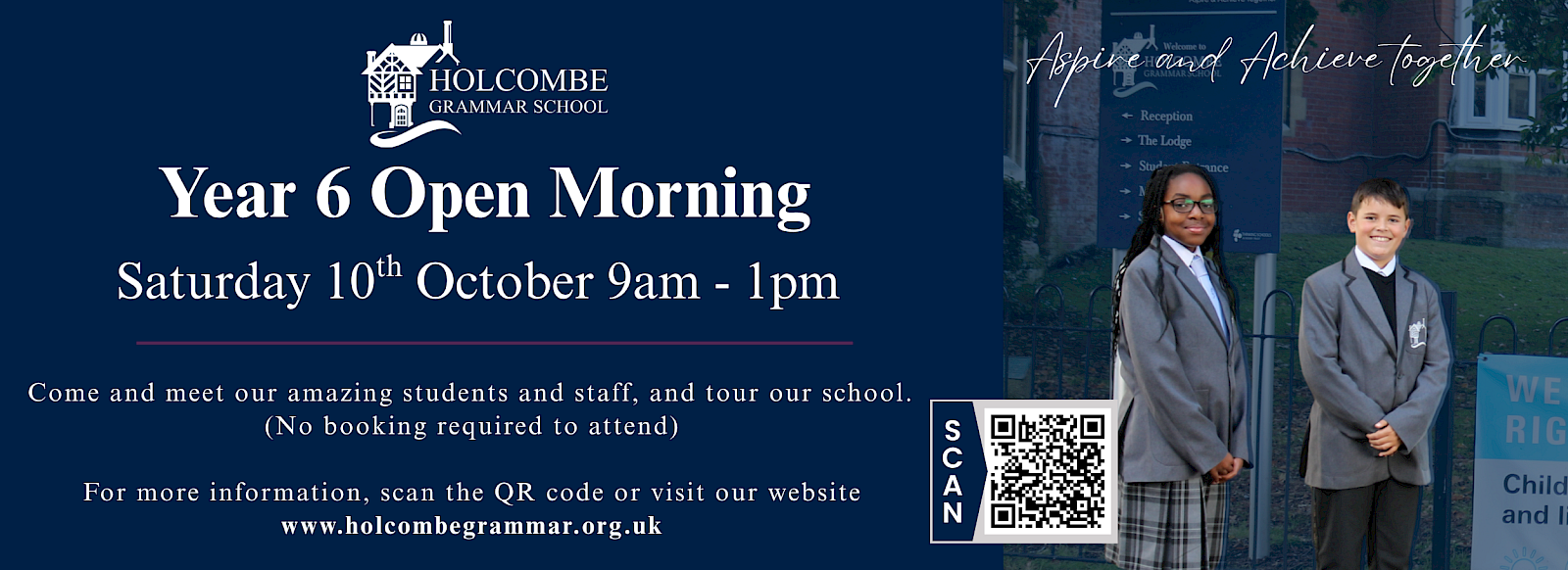
Interested in seeing Holcombe Grammar School in action for Year 7 intake September 2027?

To book onto a morning tour, with arrival by 8:50am for a 9am start, please click here.

We have a limited amount of spaces available for each day.  If we are unable to offer the date you have chosen, we will make contact with you to offer an alternative date. Please take note of the date you book as a confirmation isn't sent straight away.  You will receive an email reminder of the tour you booked a day before. 


Interested in joining Holcombe Grammar School Sixth Form in September 2026?

Unlock your potential and join a vibrant, ambitious community at Holcombe Grammar Sixth Form. Apply now to explore inspiring courses, exceptional teaching, and a supportive environment that prepares you for your future goals. Click this link to register your interest and begin your journey with us for September 2026.
Thinking Maps

Thinking Maps

The infusion of Hyerle’s Thinking Maps across the whole curriculum has provided our students with a method to sort and present information, providing a rich vocabulary to express and discuss their ideas in relation to the content they are studying and their underlying thinking.

How Are They Used?

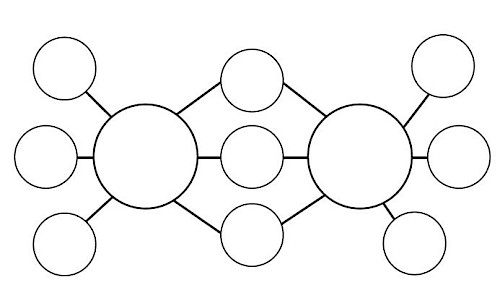
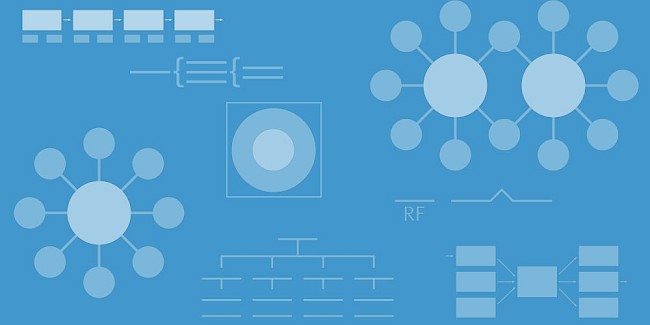
The application of a Map to a task is not arbitrary – each Map links to a specific thinking process which is informed by the nature of a specific task. For example, in English, comparing and contrasting two characters using specific terminology could be supported by the use of a double bubble map. All learners within the class might use a ‘double bubble’ to share their ideas but the task might be differentiated through the application of a relevant ‘Frame of Reference’. These frames add a level of teacher and student flexibility to the highly structured Maps, which otherwise might be too rigid.

Thinking Map

Thinking Process

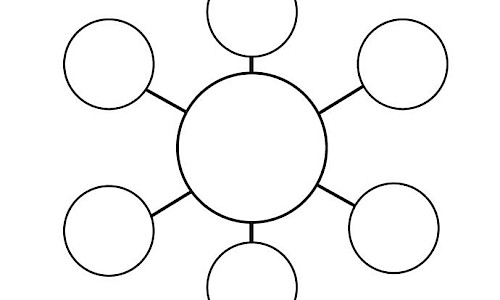
Bubble Map

Describing

Double Bubble Map

Comparing and contrasting

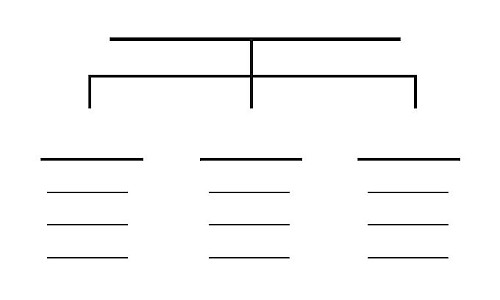
Tree Map

Classifying

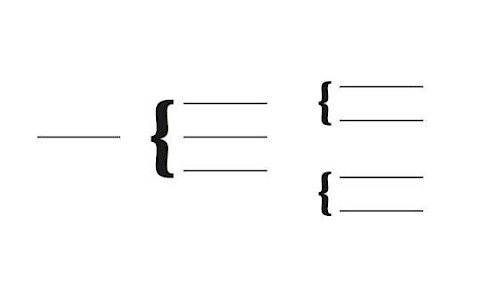
Brace Map

Identifying whole/part relationships

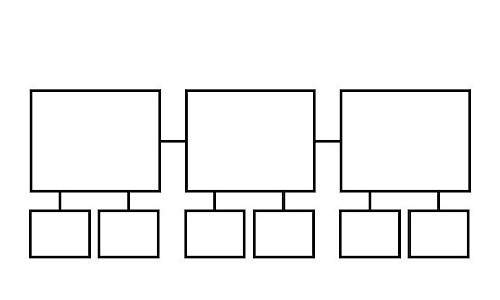
Flow Map

Sequencing

Circle Map

Defining in context

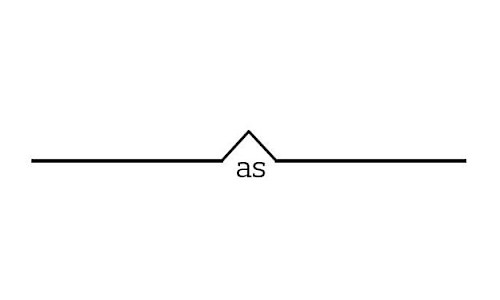
Bridge Map

Seeing analogies


Thinking Toolkit